
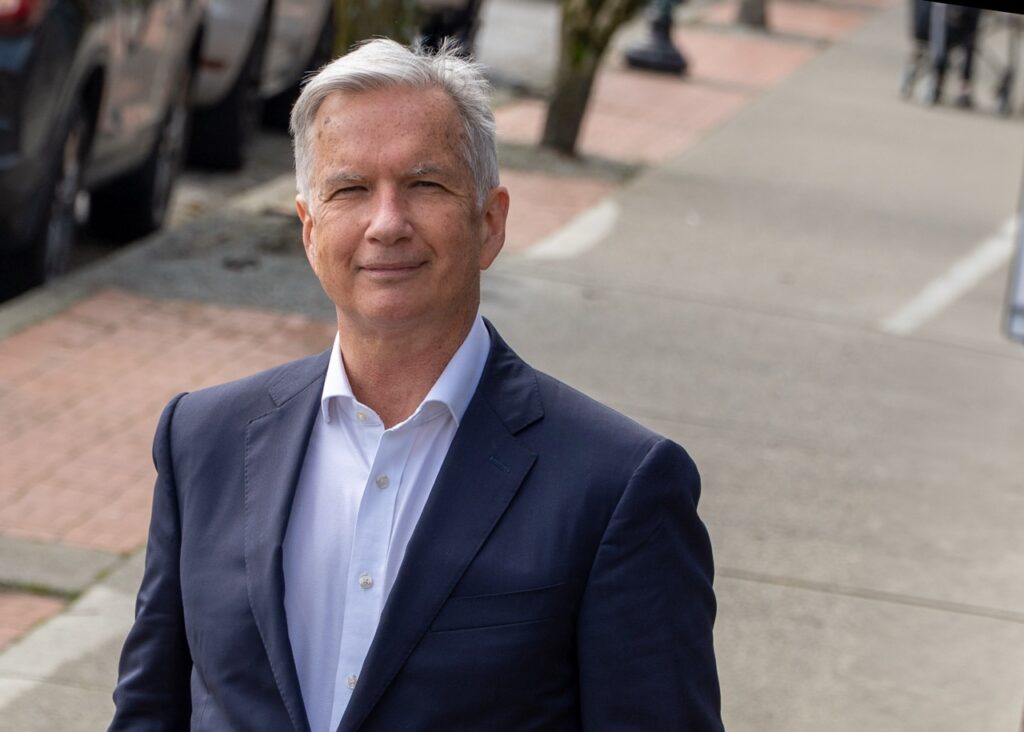
Listen to the full podcast from the Conversation Lab:
Transcript below:
Kirk LaPointe
DON SHAFER: Welcome to the Conversation Lab. I’m Don Shafer. For more than four decades, Kirk LaPointe has been one of Canada’s most respected journalists, editors, and media leaders. He’s covered politics from Parliament Hill, led some of the country’s largest news organizations, helped launch media ventures, taught generations of journalism students, and spent a lifetime asking other people questions.
And now, as a candidate for Mayor of West Vancouver, he brings a lifetime of observing public life into a new role. Seeking to help shape it. So today the questions are for him. But this conversation is not just about politics.
Before we talk about campaigns, priorities, and the future of West Vancouver, I want to spend some time getting to know the person behind the public profile, the experiences that shaped him, and what’s brought him to this moment. I hope you can join us. I always worry when I do an introduction that I miss something. So if this was the beginning of a new class here, how would you introduce yourself? And how would you fill us in on who you are and what you do and why you do it? I think the resume is almost too long.
Someone tried to do this at a meet and greet session for me about three weeks ago. And even I was upset with it. It was that long. And so, you know, it’s kind of like I’ve led organizations like CTV News and Seldom News and the Hamilton Spectator.
I’ve been a managing editor at the Vancouver Sun. KIRK LAPOINTE: Ottawa Bureau Chief of the Canadian Press, host on CBC News World, later the Ombudsman at the CBC, ran VIB, was the publisher and editor and VP of editorial at Glacier. And I’ve been writing columns now for about a decade for the chain. I write for the Hub in Toronto.
I’m teaching at UBC. I’ve been there for 22 years. And yeah, I got my start in writing about music, you know. Cashbox and Billboard for nine years.
DON SHAFER: Let’s talk about that for a second. I just want to get, transport us back to Ryerson running the campus radio station and writing for Cashbox and Billboard. That’s pretty cool. KIRK LAPOINTE: It was really cool.
Those were great times. And I also had at the time, I had a community cable television show.’d been a student council president and I had written the McLean Hunter cable company to say, you Don’t do anything for students. And so the guy wrote me back and said, well, okay, go ahead. One hour.
Yeah, one hour on Thursday nights. And that’s how easy it was. And I had a student show and I ran out of ideas for students about four weeks in. And I just decided to do a music show.
And it was before Much Music. I think the new music was just getting going with J. D. Roberts, John Roberts now, very August broadcaster, and Jeannie Becker.
And they were just starting. At Moses Dimer Station, but I was the only other game in town in Toronto. And so, bands would come to town and the publicist would feel a bit embarrassed if they didn’t do some TV. So maybe they would get Jeannie and JD to come by, but they also had this kid who had a cable TV show.
And so I did interviews with band after band after band after band for a community channel show, which was highly regarded, highly rated. I mean, every teenager. In the west side of Toronto and into etobicoke was watching the show at Thursday at eight o’clock why because their bands were on they were talking about their music the station had no money in a strict sense so we couldn’t do any performances because we would have to pay so can or whatever like yeah but i’d do an hour with them and we’d open up the phone line so i i’d maybe talk for like 20 minutes half an hour with them and then and then we opened the phone lines and people would be crazy. Like, they’d be mad.
The lines would light up. Half an hour before the show and stay up. Like, it was, it was madness. Dave Bedini, who was actually watching my show a lot.
And when Rush got into the Rock And Roll Hall Of Fame, Dave Bedini had to write a big piece on him. And he talked about how that show had sort of saved his life as a teenager. That was pretty funny. Anyway, so I did that.
I did that for four or five years. What a great experience. Oh, oh man. Of course.
I mean, I like all the bands and, and then I, and then I got like actual, like real, a professional thing with first cash box and then a Billboard, David Farrell, the late David Farrell, preceded me in both those jobs. And I’d written for him at a publication called record week, which was owned by Joey C who’s still alive. I still stay in touch with Joey. Yeah.
It was fantastic. I mean, you know, if you can find a way to make journalism even more fun than it is, please. That was a great start for you there were days Don when the postman would arrive with 20 albums and the good news is i didn’t have to review them i was just writing about the industry so i just had them for my collection so i was obsessed with music no and and the bands they were all very obliging there weren’t many that were really standoffish they all wanted to i mean it was it was as you know i mean it was really the halcyon days of the industry everybody had money everybody had debt as well i found a lot of a lot of bands i would interview would start crying at the amount of money that they owed it was really quite extraordinary and if you had a hit record you were done for life you were you were made you know made in the shade you know now it’s a struggle but i i i had a great time i met so many interesting people and and it just i i hate to say it but it kind of imprinted in me a kind of a ridiculous youthfulness that lasts to this day. I still listen to new music all the time.
I love it that I listen to. I was lucky. My mother worked in a factory and they gave her the morning off in 1964 to go to line up at Maple Leaf Gardens for tickets for about eight of her friends for The Beatles. And she got tickets.
And on the day of the show, one of the daughters for these women woke up with a cold and she couldn’t go to the show. So six-year-old Kirk LaPointe got to go to the show. And yeah, my children this Christmas bought me a ticket embossed in plastic from that day, which was pretty exciting. Yeah, you know, if the Beatles can’t change your life, nothing can.
DON SHAFER: What a great memory and gift from your mom. KIRK LAPOINTE: Oh, of course. Yeah, she was always, she was heroic, single mother, tough life that she had had. And she tried to make my life as least tough as it could be.
But we didn’t have any money. And, you know, she would get paid on a Thursday. And by Tuesday, we were almost always without food in the fridge or the cupboard. And so I would move around the neighborhood.
I had lots of school friends. You know, those were the days where you could frankly roam the community and nobody was. Going to be wondering what the heck’s this seven or eight or nine-year-old doing on the street alone. So you could just do that.
And, you know, I’d get a bowl of soup, sandwich, sometimes a hamburger from people. It wasn’t the best food in the world, I wouldn’t say, but it kept me from real starvation. But there were many nights where I went to sleep without having had a meal. So it gave me an appreciation for poverty, of course, although you never realize that you’re in poverty when you’re in it.
You only find out later on, Tschüss. How the rest of the world actually can live. And then you go, oh boy. But I still can summon the somatic quality of hunger, the hunger pang.
I was really, really privileged for a very brief time to chair a not-for-profit recently called KidSafe Project Society in Vancouver, where we fed children and gave them activities during school breaks. There are about 400 children in seven schools in Vancouver. It’s an old organization. It’s about 35 years old.
But when I became the chair of it, we then moved it into the Boys And Girls Club. And they’re great. They’re just the best. So, you know, I was happy that we were able to kind of move it off to a place that had more sustainable financing.
And I was going to look after it, be very attentive. But there’s a huge need there. And so I have in my heart places for children and food and children and reading. So those have been my two main.
You know, volunteer things over the years. DON SHAFER: So your mom and growing up in Toronto had a huge impact on everything you do. KIRK LAPOINTE: Oh, yeah. Toronto’s great.
I Don’t miss the winters. You know, I Don’t have the same broad shoulders from shoveling my car out, you know, and then going back and looking at the car and realizing I’ve got to shovel the driveway again to get the car out. Stuff like that. I Don’t miss the winters at all, even the summers.
When I go there in the summer and it’s humid, it acts up, you know But no, this is a very different climate out here. I Don’t miss that part of it. But, you know, life comes full circle. By virtue of DNA testing, I eventually found out on the basis of the name my mother had provided me of the man she’d had a really brief relationship with, who studied Looker up again and never did.
Through DNA research, I found a sister in Toronto. And then I found a brother here in British Columbia. And as it turned out, my father planted roots in West Vancouver. So there you go.
How strange is that? DON SHAFER: What a remarkable story. Wow. KIRK LAPOINTE: It’s not an uncommon story, but when people Don’t have those stories in their own circle, I mean, they think it’s pretty extraordinary. But there were 600,000 Canadians who were born out of wedlock between the end of the Second War and the beginning of birth control, 1971.
So there are lots of us out there. DON SHAFER: I really appreciate you sharing that story with us. So did that quest bring you west? KIRK LAPOINTE: No, I came west for love. I met somebody.
And came out here and took on other jobs and things. And I didn’t move to West Vancouver until really about five years ago. I lived first in Vancouver, then on UBC campus, then back in Vancouver, then here. DON SHAFER: I’m fascinated because you’ve worked with some of the largest news organizations in Canada.
What was it like inside those newsrooms? What did you learn about leadership? And probably more importantly, what’s changed? KIRK LAPOINTE: Well, I think the biggest struggle for me was, number one, I was sort of still very young. I mean, I was a manager when I was 27, and everybody else in the organization was older than me. I mean, I did learn very quickly that you have to respect experience. You have to work collaboratively.
You can’t have all the ideas. On your own. There are people with better ideas. There are smarter people always.
And I guess I evolved pretty quickly on in leadership to an ethos of basically saying there will always be smarter people around me, but nobody can outwork me. And so that’s why, when I was at the Canadian Press, for instance, and I went to Ottawa when I was 23, I was the youngest person in the parliamentary press gallery. Pierre Trudeau was still there. I still had a side hustle, like I was writing for a cash box.
And then I ended up writing for Billboard. I was writing for all kinds of things that were extensions of the base that I had. And I’m having trouble still unpacking why I did so much as I did, because I could have done a lot less and probably been more effective in some ways. But I did a lot of those types of other jobs.
And then I came to the attention of CBC. Carol Reynolds was an executive there. And I was introduced when I was a music writer to her. And she thought maybe I’d be OK on TV.
So she offered me a role of fronting these half hour documentaries that the CBC was doing on Canadian bands. But I did the first documentary for the CBC on the Tragically Hip. DON SHAFER: That’s very cool. KIRK LAPOINTE: And they I think they still used a snippet of it.
When Gord Downie, the unfortunate Gord Downie, the late, great Gord Downie, did that last tour and CBC carried that last show. And yeah, I mean, I got to do that all the while as I was writing for communications and transportation and parliament. And so, you know, I got to do some really very, very fascinating things at a very early age. And then the management jobs just kept coming.
And I kept getting different muscle groups. I learned how to manage, learned how to read an income statement, knew how to balance the budget, came up with lots of ideas, sought lots of advice, got better at it to the point where then I was able to actually lead some organizations. And so, you know, with the Canadian Press, I moved up the ranks pretty far. And then I took over Seldom News, a competitor, and then went to the Hamilton Spectator.
And then we helped prototype National Post, which, you know, for video, you can see over my shoulder here. There’s a prototype of the paper that actually preceded the National Post. We were calling it Times Canada. But then they bought the Financial Post and traded some property and money for all that.
And then it became the National Post. And I was the executive editor when we started that. That was an exciting project. It was pretty extraordinary.
Didn’t stay a long time. I went back to Hamilton. I was, the commute was killing me from Hamilton to Toronto every day. And the paper had been sold a couple of times.
And so they invited me back to be the… Assistant publisher and editor again. And I thought I’d stay there. I thought I’d live out my life.
And then I got headhunted to run CTV and took that over. I didn’t know it, but they were planning a big convergence of the Globe and Mail, CTV and simpatico.ca. And they wanted a guy running CTV that had experience in print and in digital, and then ended up at the Toronto Star and then moved out here. It was only when I moved you to Vancouver of all things that I kept the job for a very long time.
It was seven years with the Vancouver Sun. I hadn’t had a place or a job that I’d held for more than about four years at that point. I mean, that’s how rapid growth could be in your own career trajectory could go. And these days you can sometimes have longevity, but as you know, I mean, it’s very almost convulsive in the way that it moves people in and out.
And, you know, it’s not always pretty. So yeah, I feel like I had the most blessed career and a really good resume. Now I can kind of see how it’s useful and I’m trying to employ it in lots of other ways. DON SHAFER: So how has that impacted your teaching? KIRK LAPOINTE: Mostly teaching has helped my journalism because I’ve learned every year about renewal and obviously firmed up a lot of my own precepts about the craft.
So in teaching what you think you know, you actually then get to breathe it a bit. And explain it. And it helps your own mind. It’s not, you’re not just trying to transmit and discuss with students, but in your own mind, you’re clarifying it so that, you know, you, you have, I think.
You know more of a commitment in it than than never really having discussed it’s like i’ve got 35 people to discuss something with here the model is interesting too because when i started 22 years ago doing that it was a broadcasting model i mean you stood at the front i had a three-hour class and we would take a couple of coffee breaks but it was like Curricula point talking, And maybe every once in a while asking a question of the class or having a hand go up. But that is totally wiped now. I mean, now it is like, you know, it’s like one of those old Phil Donahue television shows where you’re walking around with a microphone and everybody’s talking. And it’s all you can do to get in like a little bit about it.
So now it’s now more of a conversation, a group conversation. And I can see where it actually is more effective. And so I then use that as well in how does it work. Which is that it needs to be a group conversation.
I might have some ideas. I might have an objective, but I need to hear from everybody. And it’s not just for me, it’s for each other. You need to have that, which is why I’ve been a bit of a strenuous opponent on remote work, because I think it has lost a lot of that dynamic, even though you and I can see each other on Zoom here.
DON SHAFER: Not the same. KIRK LAPOINTE: We Don’t have all of our body languages even available to us. We Don’t see somebody fiddling with a paper down on the desk. We Don’t see so much that kind of matters.
And then once we’re done with our meeting, we all move off and we go to the bathroom, we go to the water cooler, we go walk and wander around. And honestly, that was what a lot of people always told me was the necessary part of the craft of journalism, which is that you generally go around and make an idea better. By doing that. So yeah, we Don’t get to do that.
And I think it’s a big loss. I think this generation is going to regret that whole inflection point of COVID that sent us all back and gave us, you know, gave us some freedom to manage our time a bit better. And that’s probably not altogether bad. However, it came at a cost.
And I think that the cost is kind of, like my old newsroom at the Vancouver Sun isn’t a newsroom anymore. There is no newsroom. They’re all working from home and the quality of the work still there. But I would bet it could be even better if they were all talking to each other, grabbing coffee with each other, arguing, kibetching.
So I think we’re missing them. DON SHAFER: Let’s move from journalism to the city of Vancouver. So why did you run for mayor of Vancouver? KIRK LAPOINTE: I kind of dropped into it. It was never a plan.
A friend invited me out. And 45 minutes into it, we start talking about politics. And he says, well, what do you think about municipal politics these days? And I said, oh, you know. I’m not a big fan of the mayor.
And, but you guys, you know, your party that you’re, you’re in, I hear you’re not even going to run a candidate against him. And he said, what about you? And I said, yeah, no, Don’t worry. It’s fine. Yeah.
Good joke. He said, no, no, I’m here on behalf of nonpartisan association to ask if you would stand for the office. And my first response was, so am I like the 58th or the 59th person to do that? Like how, how far have you gone? Was there somebody not between between the parking lot and the restaurant that was actually better than you could have asked before me and it’s no no no your resume is really good you’ve never really you’ve never been politically aligned you know you you fresh face and i still was waiting for somebody to come out from behind the wall and point to the camera and go you know like we really had you there didn’t i boy you we had but no it wasn’t so i had to give it some thought you It took me a while. I had to go meet a couple of people that were involved in the party and make sure that I could kind of explain myself.
And honestly, I was a rookie. I’d been around politics, of course, you know, I’d interviewed prime ministers and heads of state and mayors galore and all that. But it’s totally different when you have to start thinking about whether you could hold the job. So I had to really think long and hard about it.
I had to do the same. My wife had to do the same thing. And we went into it with kind of reasonable expectations. But lo and behold, we found that there was a lot more animus toward the administration than I think anybody thought.
And so it became a close race. And we were doing a lot of polling. I was appointed in the campaign where we were actually ahead by a couple of points. And then it became, well, actually, now it looks like these policies that I’ve been talking about have the potential to convert into an office.
So let’s get, you know, let’s get ourselves at least prepared for the possibility of it. And then in the last week of the campaign, the mayor apologized. I mean, he gave this kind of blanket apology. We were on CBC radio together in a debate.
He gave an apology and I would have liked to have responded, but it wasn’t my turn to speak. And so the third candidate moved the whole conversation away, didn’t even pay much attention to it. And we never got back to it. I wasn’t able to get back and kind of say, well, what are you apologizing for? Specify, because an apology about everything is an apology about nothing.
It turned everything around in the last few days. Like they… Bounced about four or five points like we didn’t have another gear at all. And it turned out it worked.
It was clever and we were outflanked. But, you know, after that, I gave a really serious consideration to running again and decided not to in 2018 and really closed the door. I thought that that was it. Moved here to West Vancouver and was actually writing a column for the North Shore News.
I was the vice president of editorial for the chain of publications that included the North Shore News. I was writing a column every week for business in Vancouver on business and politics and decided I was going to assert executive authority and just write a column at the North Shore News every two weeks on what it was like to live in West Vancouver. I was almost like a foreign correspondent. And, you know, there was air in my backyard and like all kinds of things, free parking, for goodness sake.
And all sorts of cultural things that I was learning about. And one of the things I was writing about right away was the administration and the mayor in particular. And so I thought sometime this term, somebody would raise their hand and say, I’m going to challenge the mayor. And it didn’t happen.
And so probably about a year ago, I began to more seriously consider doing this again, trying it again. And here I am. As we speak with an objective to be the mayor of West Vancouver. And I’ve learned a lot in living here about four and a half years, maybe a bit more now.
In journalism years, that’s about 100. You know, like dogs. DON SHAFER: Yeah, yeah. KIRK LAPOINTE: You know, if you’re a journalist, you’re voracious for information.
You can’t satisfy yourself sufficiently. You’re reading everything, talking to everybody, learning everything you can. So I feel that even in a short amount of time, I’ve developed a feel for what this place is like, the kinds of things I’d like to protect, the number of things I want to change. And so, yeah, here I am.
DON SHAFER: I admire your courage. So why do you want to be mayor? KIRK LAPOINTE: Every mayor, well, every candidacy, Don, starts with the incumbent. And so if you’re not pleased by the incumbent and you feel like there is a better path for the community. Then that is what activates candidacy.
And I’ve talked to a lot of people who have taken on incumbent leaders, and they tell me roughly the same thing. You know, it’s senseless to try to take on an incumbent if you Don’t have a better plan, and if you’re not really disquieted by their performance. So I was. And I think that it’s a community that is gorgeous, really pretty much a paradise in terms of its mountains, ocean, land, beautiful slope.
The canopy here is extraordinary. And, you know, it’s affluent for the most part. There are lots of people not living the dream. It’s a really well-educated population, quite professional in caliber.
And so I feel at home here and I feel that there are things that can be done to improve upon it. You know, I’ve set myself out a campaign that’s like an investigative journalism project. I’m talking to everybody. I’m listening to everyone and I’m learning quite a lot.
Mostly, I would say it’s validating my precepts about the place. I’m not getting surprised a whole lot. So the affirmation is very healthy for me because I suggest that I had generally the right instincts about it. But the fine details are the kinds of things that people are helping me with.
And I sense an appetite for change. I do believe that the place wants some change. And I think that there are things that can be done that are kind of a form of safe change for the community. So I worry about our public finances.
Municipalities, as you know, have taken on more and more things as senior levels of government have run into financial difficulties. And they just dropped down and we’re the last lines of defense. And so I worry a lot about the future of municipalities and how seriously strapped they’re going to be. They’re not allowed to run deficits.
So you’ve got to live within your means. You’ve got to find ways to make budget every year. And you can’t really fiddle with that. So, you know, going back to my early days of being a child and having a respect for dollars, I have a really ingrained respect for how money is managed.
And I think it can be managed quite carefully and more intelligently than it has been. And so that’s part of my plan. DON SHAFER: So where do you feel the tension is in the community? KIRK LAPOINTE: Yeah. Around affordability, everybody’s aboard.
Even wealthy people feel an affordability pinch. They feel their house equity is there, but the house value is in a bit of a reset right now. So they’re concerned about it because it affects overall how much tax they end up paying. The tension here is around development.
And it’s a tough needle to thread because nobody wants the character of the community to be changed. And yet most people, I think, recognize the need for some form of renewal and modernization because we have some very old structures here. So, you know, I think the challenge for any leader here is to try to find the ways to thread that needle so as not to antagonize neighborhoods and blocks and yet establish a stronger, more sustainable form of revenue through property tax. West Vancouver is peculiar in a lot of ways, but…
One of them is that we Don’t have any industrial land. So we Don’t have that tax base that municipalities typically get a lot from. So we’re really into property tax, residential and commercial, and that’s almost about it. So yeah, we really do have to focus in on that and not hurt neighborhoods all the while trying to improve them.
So along has come the provincial government that has brought a pile of legislation that imposes housing targets for this community and for all British Columbia communities. And I will say it’s not been well received here because I think the fear is that it’s going to endanger the character of communities. I think it can be done gently. I think it can be done sensibly, smartly, economically to provide different forms of housing that might be relatively more affordable, not all be monster homes and large mansions and single family homes.
But I think it’s a big challenge for all the leadership, as it has been for years and will be for years. It’s a never-ending discussion here. DON SHAFER: When’s the last time West Vancouver’s OCP was reviewed? KIRK LAPOINTE: Oh, it seems like every couple of months. DON SHAFER: Okay.
KIRK LAPOINTE: And there’s a lot of local area plans inside it. And this was a community that actually was spanked by the EB government and where a local area plan in the most dense leap. Populated part of the community was entrenched. They were dithering about it for years and bouncing stuff back and forth between staff and council, staff and council, to try to come up with the plan.
And the province grew impatient. Even though it was expected that there was more time to go, the province said no. And so an order in council imposed the plan now. So it’s locked in and you can’t digress from it.
But all you can do is be right at the edges in terms of the bylaws for it. Same thing has come along now where single family lots and West Vancouver is, it’s ostensibly the style of housing we’ve got. Those can now be turned into four and in some cases six units. We’ll see how that goes.
I guess there’s a slight reprieve in it and that people are not building terribly much. There doesn’t appear to be voracious demand and it’s expensive to build and there’s still a lot of costs that are applied to it. By municipalities, you know, all over the place. So we have a lot of developers who live here who Don’t develop here.
They develop everywhere else. They find it a lot more hospitable. So there’s a reprieve, if you can call it that. But it won’t be long before building is taking place in that local area plan and where people will start to feel like there’s an economic way of adding units to their property and profiting from them.
So I can see that today is coming. You know, we’ll have interesting discussions in the years ahead. DON SHAFER: Do you think most people in West Vancouver are aware of the OCP and what the OCP does in its relationship with provincial legislation? In my experience in walking around the community now in trying to build support, I think there’s a better understanding of the relationship between the municipal and provincial government around housing. Than I think most municipalities have.
KIRK LAPOINTE: And a lot of that has to do with the concerns that people have here about the imposition of the local area plan in Ambleside and the next phase of the four plexes and six plexes. And I think some of that then translates into people looking it up, trying to learn about it. There’s a fair amount written about it too. So I would say, yeah, I think we have a pretty good understanding of it.
Again, it’s a well-educated population, pretty civically engaged. In a lot of respects. I’m still always dismayed by the voter turnout for municipal affairs. So I’m hoping that this election campaign proves engaging in such a way that the turnout will come up and that we can have larger and larger turnouts as time goes on.
DON SHAFER: So what are the key issues for you? KIRK LAPOINTE: Well, some of them are journalistic. DON SHAFER: How so? KIRK LAPOINTE: Consultation, collaboration, transparency, accountability. I think that those are lacking here. They’re lacking also with our regional government.
You Metro Vancouver. I was the first journalist, well, first person, I guess, to publicly say that the wastewater treatment plant was going to be $4 billion and not $700 million. And I’ve been calling for a very, very aggressive inquiry to try to get us the answers on that, calling for a different funding formula for it. But it’s a big issue here.
This year, next year, the year after, there’s a kind of an escalation of the taxes for it, the levy for it. And then it’ll reach, on average, at this point, unless there’s some changes, it’ll be about $900 to $1,000 a household a year for the following 26 years or something. And as you can imagine, that’s not good news for people. So there needs to be a new formula for it that needs to be adjusted within Metro Vancouver.
And then I believe, too, that the federal government has to come back to the party because they only came in for a third of the original cost. And the original cost is one-seventh or one-sixth of what it is now. So they need to pony up more money, as does the province, in order to relieve the tax strain, because it’ll be a strain on the North Shore. We’re paying about 37% of the expense of the plant, and it shouldn’t be as large an amount.
So I’m hoping that they redo the formula and I’ll be pushing for it for sure. Lots of other things, Don. It’s taxes have gone up here 19.3% during this administration. They’re scheduled to go up another 20% over the next four years.
So I would say, you know, when you have a 40% tax increase between 2023 and 2030, that’s just way off the charts. So those public finances have to be brought back and be wrestled down. We also have our shopping villages are strained right now. They’re struggling in a lot of cases.
They’re a bit tired because they haven’t really been, I think, properly invested in by the community. And so we’re going to have to do something for them. And then we’ve got an older population. It’s true.
It’s 29% of the population is over the age of 65. And it has a great seniors activity center. But that center is aging out. And so there needs to be a new one there, too.
So we’ve got some, you know, we’ve got some capital projects ahead that are significant and we have to find the funds for them. DON SHAFER: What’s West Vancouver look like in the next 10 years? KIRK LAPOINTE: I would hope that the things that we love, well, first of all, we agree upon the things we love and we have to protect them. And I think all of us will fight very, very hard to make sure that they Don’t diminish. It’s the stuff that is…
Not exactly the best. That isn’t four and five star that needs to be addressed. I think we need more amenities. It’s bizarre that a place that actually has produced a lot of hockey players has the fewest per capita ice rinks of any municipality in Canada.
That’s silly. So we’ve got to do that. We have a brilliant library. It needs to be expanded.
We need an arts center in the community, and we need it in a place where people can get to it very readily. And then I’d throw another thing on the table, which is it’s bizarre that in a community this size, with this kind of demography, with quite a bit of affluence, that we Don’t have an urgent care center here. You know, we have people at both ends of the life spectrum who break bones, need stitches, have very curious pains they can’t figure out, feel sick, need attention. And they either drive into North Vancouver and wait a while with all the North Vancouverites who are also lined up.
Or drive up to Squamish, where maybe you can get seen a little sooner, but it’s still a heck of a drive. So I really believe we need one, and we need one in the most more populous parts of the community. So yeah, I want to get one of those. It’s provincial, but you work with the province, and I think there are benefactors here who will help put the bricks and mortar up.
So those kinds of things are all part and parcel of the campaign. And I’m going to go into much, much more detail on you strategies for all of that as I get toward it. I can safely say from experience that if you were to put a platform out today, three things happen. It gets stolen slash borrowed.
It gets forgotten or people do embed it, credit you for it. And then when the campaign gets busy, they expect you to have another set of them. Like, okay, so what are your really big ideas, Kirk? And so I have to pace myself on that. It’s a marathon, right? So I’ve run marathons.
I’ve run nine of them. And the biggest mistakes I always made was trying to run too fast too soon and not have much left in the tank for the end. So when the attention is on the campaign much more vigorously, I’ll be providing a plan more vigorously. DON SHAFER: What haven’t we talked about this time that we should have? KIRK LAPOINTE: Well, I think the challenge that I’ve got you obviously, even though I’ve got some prominence as a writer here and doing media over all the time that I’ve done, the life that I lead away from that is still, I think, something that people Don’t know much about.
So when we talked about music, music is a big part of my life still. I play a lot of sports. I still run after 44 years. The knees have not turned to chalk yet.
And i’m i’m a hockey goalie right i play a couple times a week been doing that for 40 years so you know what i want people to understand is that you know i’ve got two great grand you know wonderful grandchildren got a great wife i’ve got great children and what i’ve tried to learn as i as i aged out as i as i actually tried to figure out how important work is and how important family is is how do i rebalance my life so that i can stay grounded and have the relationships that I feel are necessary with that. And because it is a lot easier to just simply talk about work all the time. It’s not exactly the balance that you want at certain times of your life. DON SHAFER: I really want to thank you for hanging out with us.
This helps me and the rest of us get to know you even better. So thank you. KIRK LAPOINTE: Don, it’s always a pleasure. I mean, you’ve been quite a mentor in a lot of ways.
We sure had a great time at Roundhouse Radio there for those nearly four years. I think we went on the air the night of Justin Trudeau’s arrival, if I’m not mistaken. It was almost that time. DON SHAFER: I think you’re right.
KIRK LAPOINTE: So, yeah. I think on the station, I think I interviewed 3,000 people. I think it worked out to 3,000, which is really wild. Yeah, I mean, the privilege, the advantage that these…
Kinds of roles give you are really not to be beat. They’re just exceptional opportunities. And you get to meet so many fascinating people. It’s quite a life that I’ve been lucky to lead, and I really have been lucky.
DON SHAFER: Listen, I wish you the very best. I will keep my fingers and toes crossed for you. Hopefully, we will circle back again and maybe have another conversation. KIRK LAPOINTE: I’d love to do that.
Yeah. It’s a, it’s, it’s a. Form of progress at some point toward figuring all of this out. Thanks, Don.
DON SHAFER: Thanks, Kirk. We’ve been talking with Kirk LaPointe, an old friend and colleague, and now a candidate for mayor of West Vancouver. For me, this was really an opportunity to catch up with someone I’ve known for a long time, but also step back from the resume, the headlines, and the politics, and hopefully help all of us get to know Kirk a little bit better. If you’d like to know more about Kirk, his campaign, and his ideas for West Vancouver, You can find him on social media.
Or at Kirklapointe.ca. That’s another episode of the Conversation Lab. This radio program and podcast is produced by CFRO-FM or Co-Op Radio in Vancouver’s downtown Eastside on the territories of the Musqueam, Squamish, and Tsleil-Waututh Nations. Our gratitude and thanks to them and the many not-for-profit organizations and community groups for their support.
If you enjoyed this episode, please consider becoming a member of Co-Op Radio to help support programs like these. And the hundreds of volunteers who make this program and others possible. If you know anyone or an organization with a story to share, please let them know about us. We can be found at coopradio.org and on many social media and podcasting platforms.
This episode was cobbled together with some help and inspiration from Kimit Seikon, Julian Anton, and Ann Watson. Music by Jason Shaw. Thanks, guys, and thank you for listening. I’m Don Shafer.